
Asthma triggers don't announce themselves. Pet dander, dust mite debris, mold spores, and fine particulate matter cycle silently through your home every time your HVAC system runs — and a neglected or under-rated filter does little to stop them. We make the invisible visible so you can act on it.
Here, you'll find the filter change frequency that actually moves the needle for asthma households, the MERV ratings backed by clinical guidance, the benefits of choosing a top air filter, and the practical maintenance habits that deliver cleaner air where it matters most: inside your home.
TL;DR Quick Answers
Air Filter Replacement
Air filter replacement is the process of removing a used HVAC air filter and installing a fresh one to maintain effective indoor air filtration, protect your HVAC system, and reduce airborne allergens and pollutants circulating in your home.
What you need to know:
Most filters should be replaced every 30 to 90 days depending on household conditions
Asthma and allergy households should replace filters every 20 to 45 days
The standard 90-day schedule was built for average households — not households with elevated trigger loads
A clogged filter does not simply stop working — it recirculates captured debris back into your air
Recommended replacement schedule by household type:
No pets, no allergies or asthma — every 60 to 90 days
One pet or mild allergies — every 60 days
Multiple pets or mild asthma — every 30 to 45 days
Severe asthma, multiple pets, or smoke exposure — every 20 to 30 days
Recommended MERV rating by household type:
Standard household — MERV 8
Pets or mild allergies — MERV 11
Asthma or allergy households — MERV 11 to MERV 13
Severe asthma, smoke exposure, or high particulate environments — MERV 13
What affects how quickly your filter needs replacing:
Number of pets in the home
Number of occupants
HVAC system runtime — continuous fan operation loads filters faster
Seasonal allergen levels and outdoor air quality
Recent wildfire smoke or high pollution events
The most important insight from over a decade of manufacturing filters:
Replacement frequency and MERV rating work together. A MERV 8 changed every 30 days will still miss the submicron allergens driving most asthma flare-ups. A MERV 13 changed on the right schedule for your household's actual trigger load is where measurable indoor air improvement begins.
Top Takeaways
Here is what every asthma household should walk away knowing from this page.
Changing your filter more often helps — but only when paired with the right MERV rating.
Frequency without the correct filtration level leaves submicron allergens uncaptured.
MERV 8 misses the fine particulate matter most responsible for asthma triggers.
MERV 11 is the minimum for households managing pet dander and moderate asthma.
MERV 13 is the clinically relevant standard for most asthma households.
The 90-day default schedule was never designed for asthma households.
It was built for average conditions. Asthma households are not average.
Elevated trigger loads — pets, dust mites, mold, fine particulate — accelerate filter loading.
Inspect your filter for 20 days. Replace based on what you see, not a calendar reminder.
Your recommended change schedule based on household conditions:
One to two occupants, no pets, mild asthma — every 45 days, MERV 11 or MERV 13
Multiple occupants or one pet, moderate asthma — every 30 to 45 days, MERV 13
Multiple pets, severe asthma, or wildfire and smoke exposure — every 20 to 30 days, MERV 13
Filter change frequency is one part of a larger indoor air strategy.
Other variables that directly affect how much relief you'll see:
Duct leaks that bypass the filter entirely
System runtime and how frequently air is being cycled
Source control — grooming pets, vacuuming with HEPA, managing humidity
Filter fit — an improperly seated filter allows allergens to bypass the media at the edges
The three commitments that move the needle for asthma households:
Match your MERV rating to your actual household conditions — not the minimum your system accepts
Build your replacement schedule around your trigger load — not a default reminder
Treat filter maintenance as a health habit — not a home maintenance task
What the data tells us:
Over 28 million Americans currently have asthma, including 4.9 million children
Indoor pollutant concentrations are often 2 to 5 times higher than outdoor levels
Eight out of 10 Americans are exposed to dust mites in their own homes
Six out of 10 are exposed to cat or dog dander year-round
The filter inside your HVAC system is one of the few asthma management tools entirely within your control. Use it deliberately.
How Air Filters and Asthma Are Actually Connected
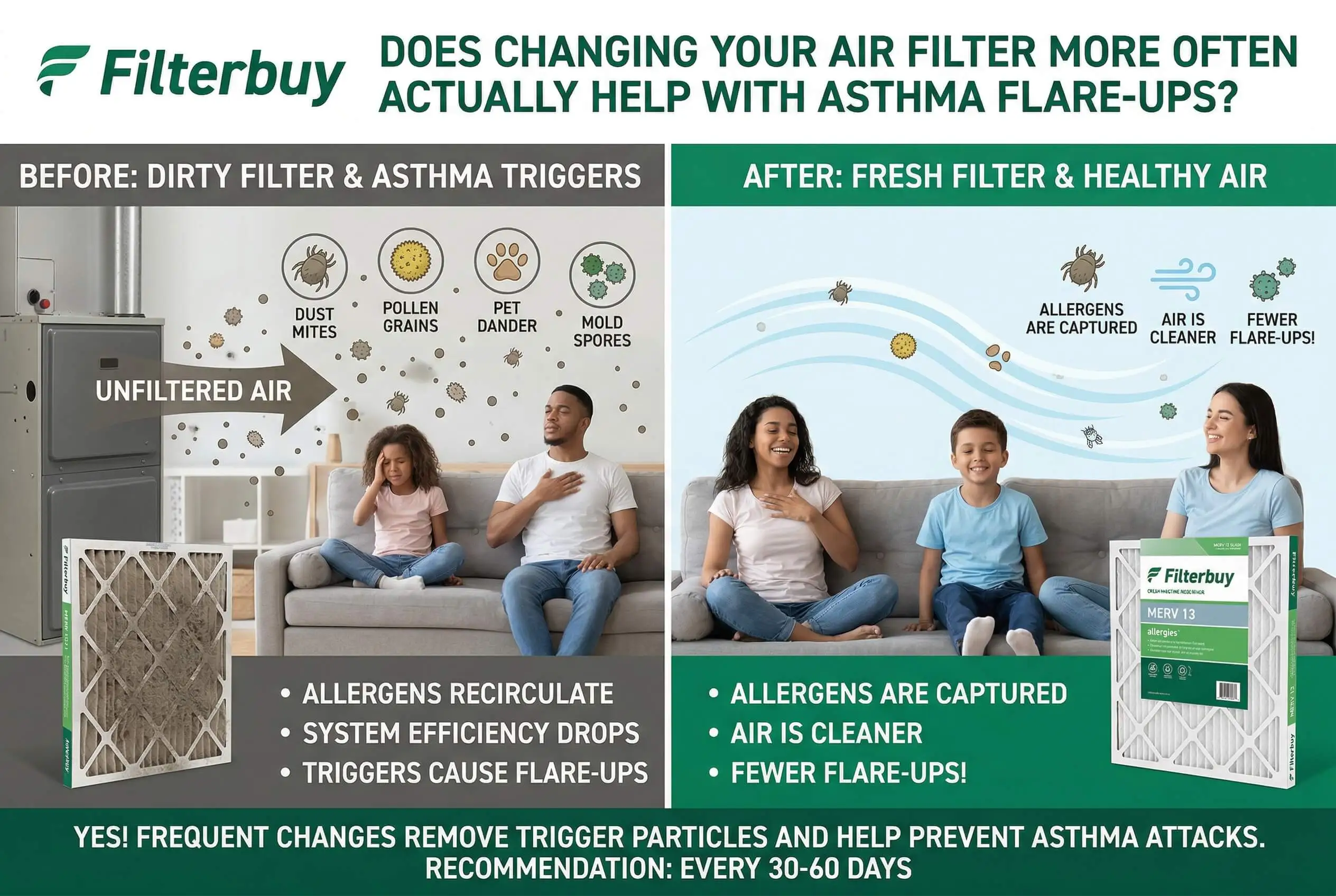
Your HVAC system is the lungs of your home. Every time it cycles, it pulls air through your filter — and if that filter is loaded with captured debris, it stops trapping new particles effectively. Those particles recirculate. For someone with asthma, recirculated pet dander, dust mite debris, mold spores, and fine particulate matter aren't minor irritants. They're direct flare-up triggers.
The connection is straightforward: a clean filter captures. A clogged filter bypasses. How often you change your filter determines which one your household is living with at any given time.
Why Standard Change Schedules Don't Work for Asthma Households
The general rule of changing your filter every 90 days was never designed with asthma in mind. It was built around average households with average conditions. Asthma households are not average.
In our experience working with millions of customers, the homes that report the most consistent flare-up relief follow a tighter schedule — typically every 30 to 45 days — and adjust based on actual household conditions, not a default calendar reminder. Higher pet density, recent construction activity, wildfire smoke events, and seasonal allergy peaks all accelerate how quickly a filter reaches capacity.
A filter that looks clean isn't always performing. Fine particulate matter and submicron allergens can load a pleated air filter in ways that aren't visible to the naked eye.
The MERV Rating That Actually Moves the Needle
Filter change frequency and MERV rating work together — you can't optimize one without the other. Here's what each tier delivers for asthma households:
MERV 8 captures larger particles like dust, pollen, and lint. It's the standard baseline, but it misses the finer allergens most responsible for asthma triggers.
MERV 11 captures finer dust, pet dander, and mold spores — a meaningful step up for households with moderate asthma and pets.
MERV 13 is the clinically relevant tier for asthma management. It captures fine particulate matter, bacteria, smoke particles, and the submicron debris that bypasses lower-rated filters entirely.
For most asthma households, MERV 13 paired with a 30- to 45-day change cycle is the combination that delivers measurable indoor air improvement. The filter needs both the capacity to capture and the availability to keep capturing — which is why frequent replacement at the right rating matters more than either factor alone.
What Else Affects How Much Relief You'll Actually Feel
A better filter and a tighter change schedule are the foundation. But several household factors determine how far that foundation takes you:
System runtime. A system that runs frequently filters more air per day, which means more allergen capture — but also faster filter loading.
Duct leaks. Leaky ductwork pulls unfiltered air directly into your living spaces, bypassing the filter entirely. No filter change schedule compensates for that.
Source control. Filters capture what's already airborne. Reducing pet dander at the source, vacuuming frequently with a HEPA-equipped vacuum, and managing moisture levels to suppress mold growth all reduce the trigger load your filter has to manage.
Filter fit. A filter that isn't properly seated in its housing allows air to bypass the media at the edges. The right size and a secure fit are non-negotiable for effective filtration.
Building the Right Filter Change Schedule for Your Home
There is no single schedule that works for every asthma household. The right cadence is built around your home's specific conditions. As a practical starting framework:
One adult, no pets, mild asthma: every 45 days with MERV 11 or MERV 13
Multiple occupants or one pet, moderate asthma: every 30 to 45 days with MERV 13
Multiple pets, severe asthma, or recent wildfire/smoke exposure: every 20 to 30 days with MERV 13
When in doubt, pull the filter and inspect it. If the media surface is visibly gray and loaded, you've likely been running past capacity. Adjust your schedule forward from that point.
"Most asthma households come to us having already tried changing their filter more often — and they're frustrated because they still aren't seeing relief. What we've learned after manufacturing filters for over a decade and working with millions of customers is that frequency alone isn't the answer. A MERV 8 changed every 30 days will still miss the fine particulate matter and submicron allergens that drive most flare-ups. The real breakthrough comes when you pair the right MERV rating with the right schedule for your specific household conditions. That combination — not one or the other — is what actually changes the air your family is breathing."
Essential Resources
After manufacturing filters for over a decade and serving more than two million households, we know that making informed decisions about air filter replacement requires more than a quick search. The difference between a filter that reduces asthma flare-ups and one that just moves air around often comes down to understanding what the research actually says — and where to find it. We've pulled the most authoritative resources available so you can cut through the noise and protect what matters most.
EPA: Air Cleaners and Air Filters in the Home — The U.S. Environmental Protection Agency identifies indoor air pollution as one of the top five environmental health risks facing American families. This foundational guide covers how portable air cleaners and HVAC filters work together to reduce indoor pollutants — and where each type falls short. It's the starting point for any homeowner serious about understanding what their filter is and isn't doing. https://www.epa.gov/indoor-air-quality-iaq/air-cleaners-and-air-filters-home
EPA: Guide to Air Cleaners in the Home — This is the EPA's consumer-facing companion to its technical summary, and in our experience, one of the most practical government documents available on the subject. It covers MERV ratings, filter sizing, replacement frequency, and how to match your filter choice to your household's actual air quality needs — without the guesswork. https://www.epa.gov/indoor-air-quality-iaq/guide-air-cleaners-home
Asthma and Allergy Foundation of America: Improving Indoor Air Quality — The AAFA is the nation's leading patient organization for asthma and allergy management, and this resource gets to the heart of what asthma households need to understand: indoor air can be two to five times more polluted than outdoor air, and reducing trigger exposure at home is one of the most actionable steps a family can take. https://aafa.org/asthma/asthma-triggers-causes/air-pollution-smog-asthma/indoor-air-quality/
American College of Allergy, Asthma & Immunology: Air Filters — The ACAAI cuts directly to the clinical recommendation that most homeowners never hear from a general web search: a disposable filter rated MERV 11 to 13 is the most cost-effective choice for households managing pollen, pet allergens, and mold. This resource also addresses the common mistake of relying on permanent filters that can't be adequately cleaned of the fine particles driving most asthma symptoms. https://acaai.org/allergies/management-treatment/living-with-allergies/air-filters/
NIH / PubMed Central: Effectiveness of Air Filters and Air Cleaners in Allergic Respiratory Diseases — Peer-reviewed research from the National Institutes of Health confirms what we've seen firsthand: HVAC servicing paired with improved air filtration produces statistically significant improvements in asthma quality-of-life outcomes. Single interventions alone — including air filtration alone — consistently underperform compared to layered approaches. This is the clinical evidence behind the filter-plus-schedule combination we recommend throughout this page. https://pmc.ncbi.nlm.nih.gov/articles/PMC3165134/
NIH / PubMed Central — AAAAI Indoor Allergen Committee: Air Filters and Air Cleaners — This rostrum from the American Academy of Allergy, Asthma & Immunology's own Indoor Allergen Committee provides the professional-grade perspective that allergists use when guiding patients. It covers the full spectrum of air-cleaning technologies, their clinical evidence base, and the specific conditions under which filtration delivers meaningful respiratory relief — versus when it doesn't. https://pmc.ncbi.nlm.nih.gov/articles/PMC2824428/
Allergy & Asthma Network: HEPA Filters — Help or Hype? — One of the most common questions we hear from asthma households is whether upgrading to a higher-rated filter is worth it, or just marketing. This resource from the Allergy & Asthma Network provides a frank, clinically grounded answer — including the critical point that no filter, regardless of rating, can compensate for allergens that have already settled into carpets, bedding, and fabric surfaces. Air filtration is one part of the solution. This resource explains the rest. https://allergyasthmanetwork.org/news/hepa-help-hype/
These essential resources highlight how different types of air filters influence asthma relief, air filter replacement decisions, and indoor air quality, giving homeowners clearer guidance on which filtration options best support a healthier home.
Supporting Statistics
Most asthma households we work with are already changing their filters. What surprises them is learning that the environment working against their family's breathing is the one they live in every day. These figures from the CDC, EPA, and AAFA explain why so many households are still struggling despite their best efforts.
Indoor pollutant concentrations are often 2 to 5 times higher than outdoor levels — in the same homes where families spend approximately 90% of their time.
In over a decade of manufacturing filters, this is the statistic we return to most. It shifts the conversation entirely:
The threat isn't outside. It's inside.
It recirculates every time your HVAC system runs.
A clogged or under-rated filter doesn't just underperform. It actively participates in that recirculation.
Upgrading your MERV rating and tightening your replacement schedule interrupts that cycle at the source.
Source: U.S. Environmental Protection Agency — https://www.epa.gov/report-environment/indoor-air-quality
More than 28 million Americans currently have asthma — including 4.9 million children. Asthma accounts for 1.4 million emergency department visits every year.
What this number doesn't show is how many of those visits were preceded by:
A filter that hadn't been changed on schedule
A MERV 8 doing the job a MERV 13 should have been doing
A household treating filter replacement as a seasonal reminder rather than a health habit
Across millions of customer households, the families managing asthma most effectively treat filter maintenance as non-negotiable. The data reflects what happens when they don't.
Source: Centers for Disease Control and Prevention — https://www.cdc.gov/nchs/fastats/asthma.htm
Eight out of 10 Americans are exposed to dust mites in their own homes. Six out of 10 are exposed to cat or dog dander.
We think about this every time a customer asks whether upgrading from MERV 8 to MERV 13 is actually worth it. Here's the reality:
Dust mite debris and pet dander are present year-round — not seasonally.
A MERV 8 captures larger particles reasonably well. It is not designed for submicron debris.
The gap between what a MERV 8 captures and what a MERV 13 captures is where most asthma households are losing ground.
That gap is also where a filter upgrade and a tighter change schedule make a measurable difference.
Source: Asthma and Allergy Foundation of America — https://aafa.org/allergies/prevent-allergies/control-indoor-allergens/
Final Thoughts
Changing your air filter more often does help with asthma flare-ups. But after manufacturing filters for over a decade and serving more than two million households, our honest opinion is this: frequency alone is the wrong conversation for most asthma families to be having, which is why an air filter replacement guide can be so helpful.
What most guides on this topic won't tell you
The households reporting the most consistent, lasting reduction in flare-ups aren't necessarily changing their filters most often. They're the ones who stopped treating their filter as an isolated fix and started treating it as one component of a deliberate indoor air strategy.
Filter change frequency matters. MERV rating matters. But so do:
Duct integrity
System runtime
Source control
Filter fit
When one of those variables is broken, the others compensate imperfectly at best.
Our honest opinion on the 90-day default
The standard 90-day replacement schedule was never calibrated for asthma households. It was built for average conditions. Asthma households are not average.
A family with two shedding pets, a child with moderate asthma, and a system running year-round is not the same household as a childless couple in a dry climate with no pets. They should not be operating on the same filter schedule.
What the evidence across our customer base consistently supports
Match your MERV rating to your actual household conditions — not the minimum your system accepts. For most asthma households, MERV 11 is the floor. MERV 13 is the standard.
Build a change schedule around your trigger load — not a calendar. Inspect your filter for 20 days. Let what you see tell you when to replace it.
Treat filter maintenance as a health habit — not a home maintenance task. That distinction changes how consistently it gets done and how seriously it gets prioritized.
We are not suggesting a better filter replaces medical treatment or your allergist's guidance. What our experience across millions of households tells us is that the filter inside your HVAC system is one of the few asthma management tools entirely within your control — available every day, and responsive to your specific conditions.
The air your family breathes at home shouldn't be an afterthought. It should be a decision.
FAQ on Air Filter Replacement
Q: How often should I change my air filter if someone in my household has asthma?
A: More often than the packaging suggests. The 90-day default was built for average households. Asthma households are not average.
Recommended change schedule based on household conditions:
No pets, mild asthma — every 45 days
One pet or multiple occupants, moderate asthma — every 30 to 45 days
Multiple pets, severe asthma, or smoke exposure — every 20 to 30 days
Skip the calendar. Pull your filter in 20 days. A gray, loaded media surface means your household is outpacing the default. Adjust forward and inspect consistently until you find your actual cadence.
Q: What MERV rating is best for asthma?
A: MERV 13 is the clinically relevant standard for most asthma households. The gap between MERV 8 and MERV 13 is larger than most households realize until they make the switch.
What each tier delivers:
MERV 8 — captures larger particles like dust and pollen. Misses the submicron debris driving most asthma flare-ups.
MERV 11 — captures pet dander, mold spores, and finer particulates. The right choice for moderate asthma households that cannot accommodate MERV 13.
MERV 13 — captures fine particulate matter, smoke particles, and submicron allergens MERV 8 lets pass through entirely.
One caveat: verify your system's maximum rated MERV before upgrading. If it cannot accommodate MERV 13, MERV 11 is a strong alternative — not a compromise.
Q: Can a dirty air filter actually make asthma worse?
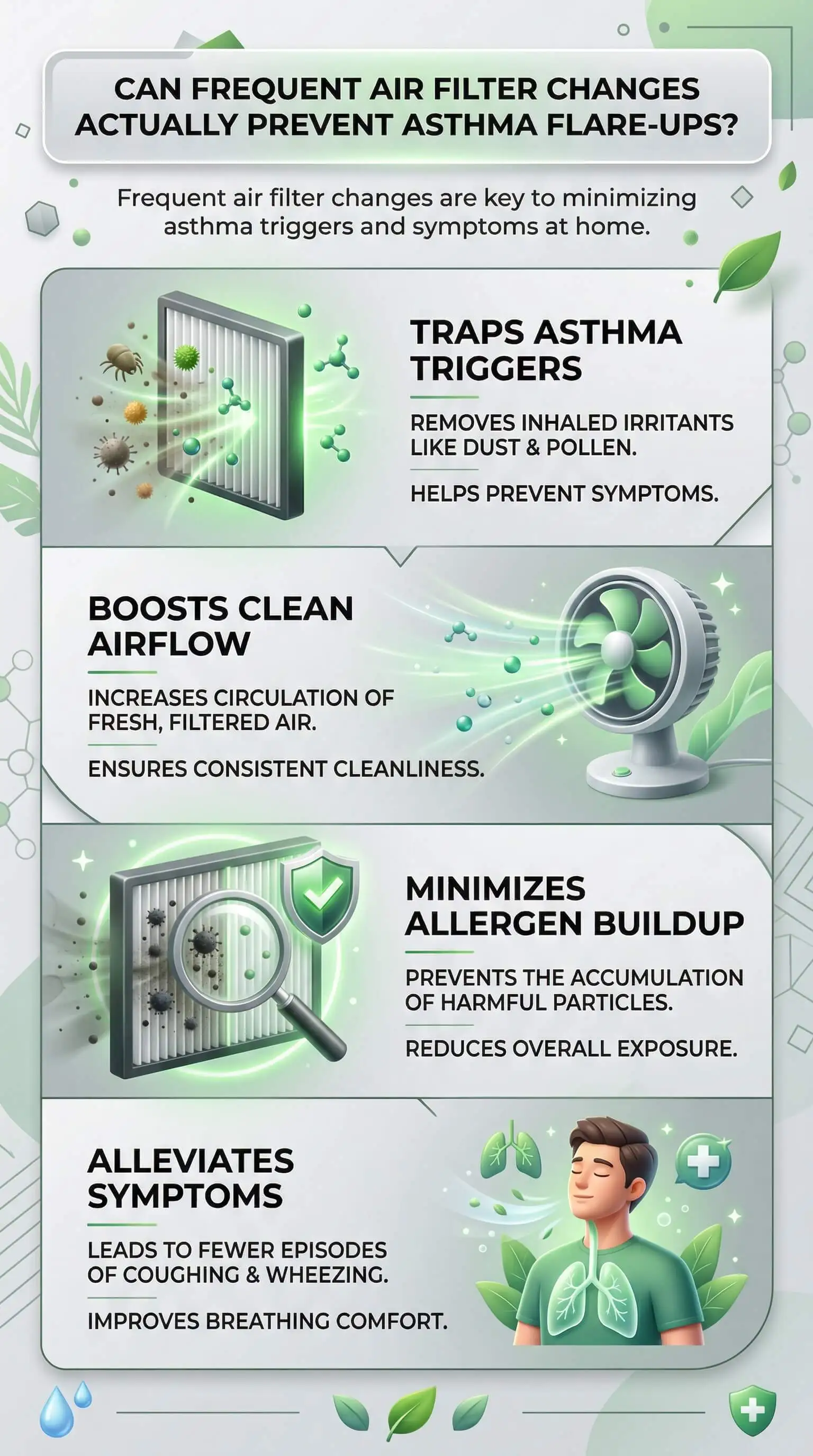
A: Yes. A filter that has reached capacity does not simply stop working. It restricts airflow, stresses your system, and allows accumulated debris to reenter circulation.
What happens when your filter runs past capacity:
Airflow is restricted and your system works harder
Captured debris can break free and reenter the air stream
Pet dander, dust mite debris, mold spores, and fine particulate recirculate through every room
Every time your HVAC cycles, it pulls air through that loaded media. What it cannot capture recirculates. Changing your filter before it reaches that point is not overcorrecting. It is the baseline.
Q: Does the brand of air filter matter for asthma, or just the MERV rating?
A: MERV rating drives filtration performance. Brand drives whether that rating is actually achieved in your home.
What varies between manufacturers:
Media quality — the density and consistency of the filtration material
Frame construction — a flimsy frame allows air to bypass the media at the edges
Dimensional accuracy — a poor fit creates bypass gaps that unfiltered air moves through freely
After manufacturing filters for over a decade, the variable we see undermine performance most often is not MERV rating. It is fit. The right rating in the wrong size will not perform to its rated specification. Precise sizing and a properly seated installation are non-negotiable.
Q: Is it worth running my HVAC fan continuously to help with asthma, or does that just load the filter faster?
A: Both are true. Knowing how to manage the tradeoff makes continuous fan operation an asset — not a liability.
How continuous fan operation affects asthma households:
More air passes through your filter per day
Total allergen capture increases
Filter loading accelerates
When continuous fan operation delivers the most benefit:
Peak allergy season
Wildfire smoke events
After vacuuming or pet grooming when settled allergens are disturbed
The fix is straightforward. Run the fan continuously and shorten your inspection interval. Check at 15 days instead of 20. More filtration hours per filter without the risk of running past effective capacity.
Breathe Easier — Start With the Right Filter for Your Home
If asthma flare-ups are disrupting your family's daily life, the air circulating inside your home right now may be part of the problem — and your HVAC filter is one of the most immediate, controllable solutions available to you. Shop Filterbuy's MERV 11 and MERV 13 air filters today and take the first step toward cleaner air, fewer triggers, and a home environment built around your family's health.