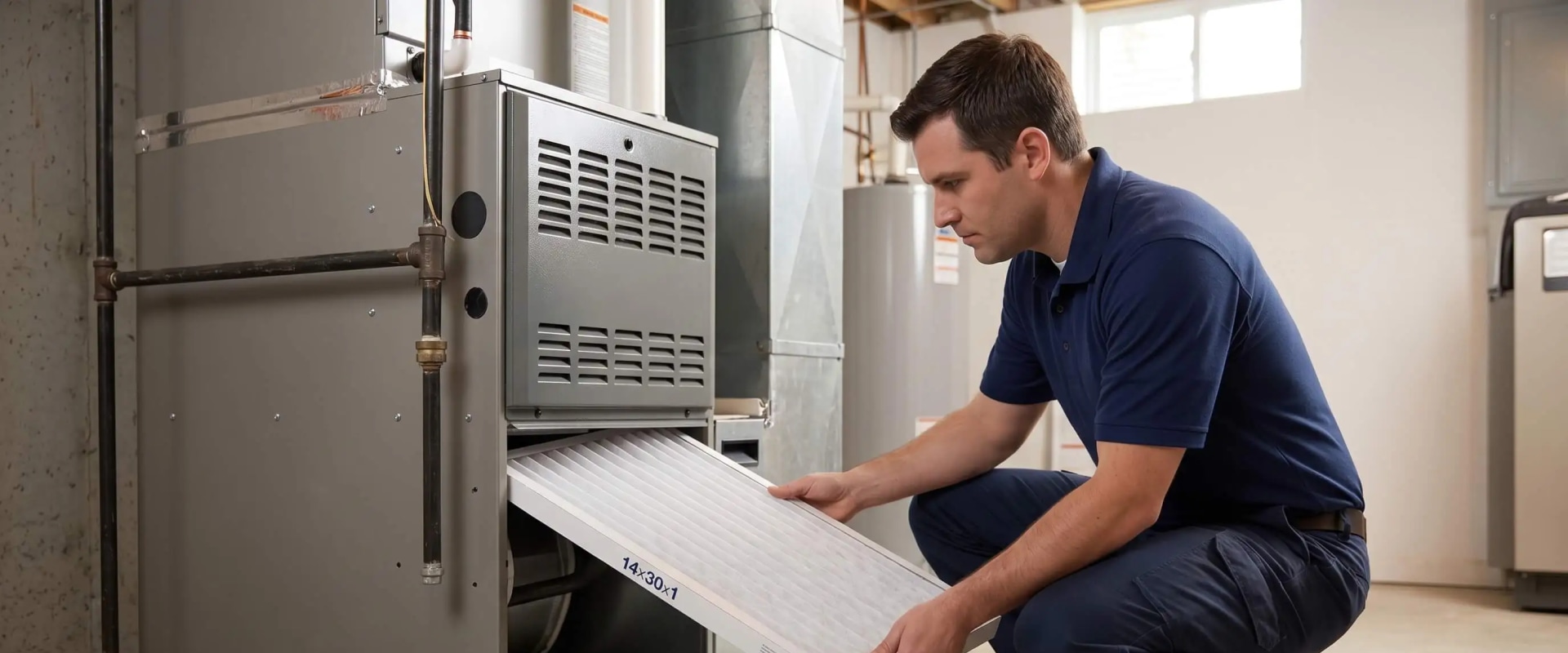
We are obsessed with indoor air quality at Filterbuy, and after manufacturing filters for over a decade and serving more than two million households, we have a real answer for when a 14x30x1 needs to come out, what early warnings to watch for, and why leaving one in too long costs you more than air quality alone.
TL;DR Quick Answers
14x30x1 HVAC home air filter
A 14x30x1 is a standard 1-inch home HVAC filter that typically fits a ceiling or wall return grille. Actual dimensions run about 13.5 by 29.5 by 0.75 inches, because the label names the slot, not the filter's edge-to-edge size.
Replacement schedule:
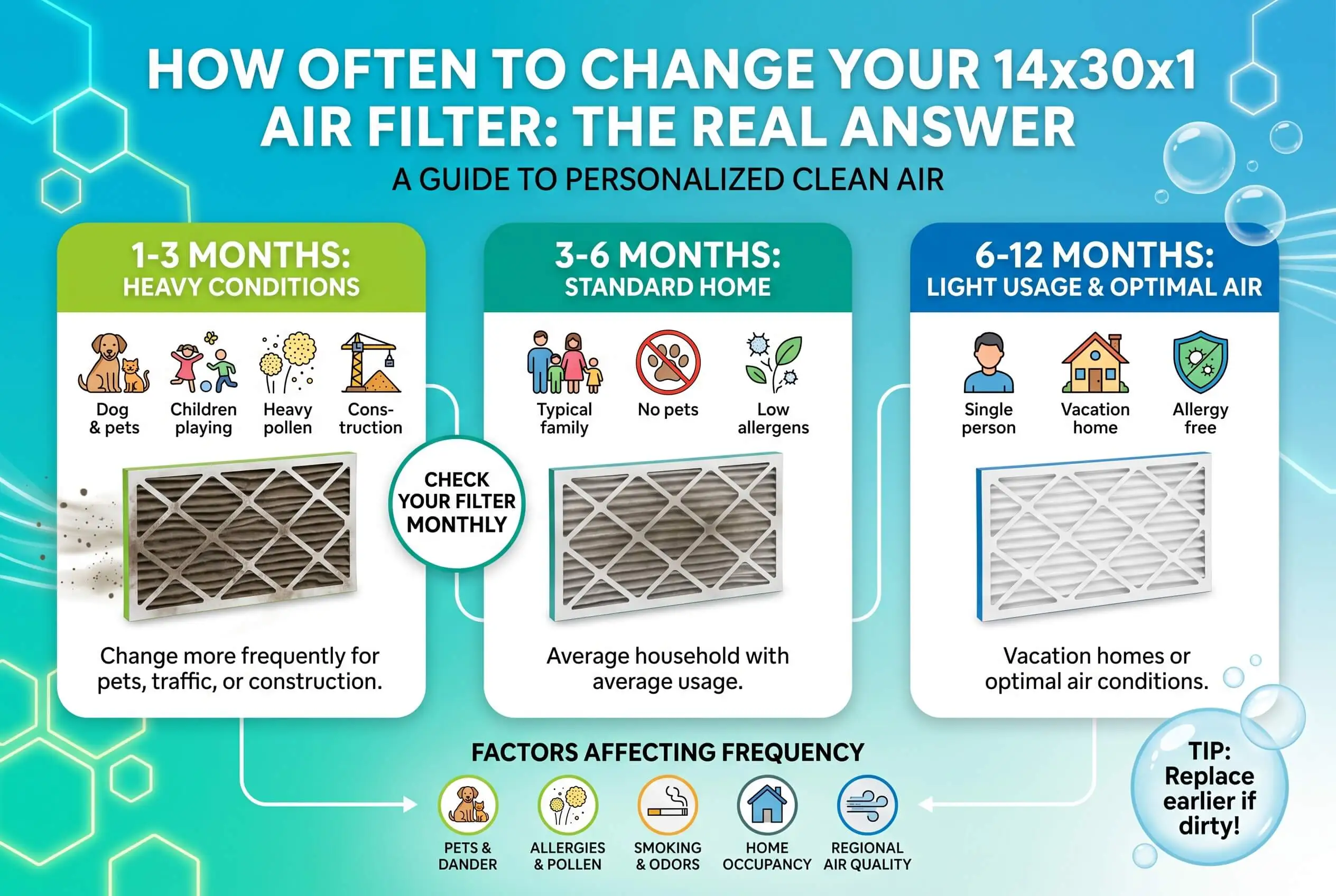
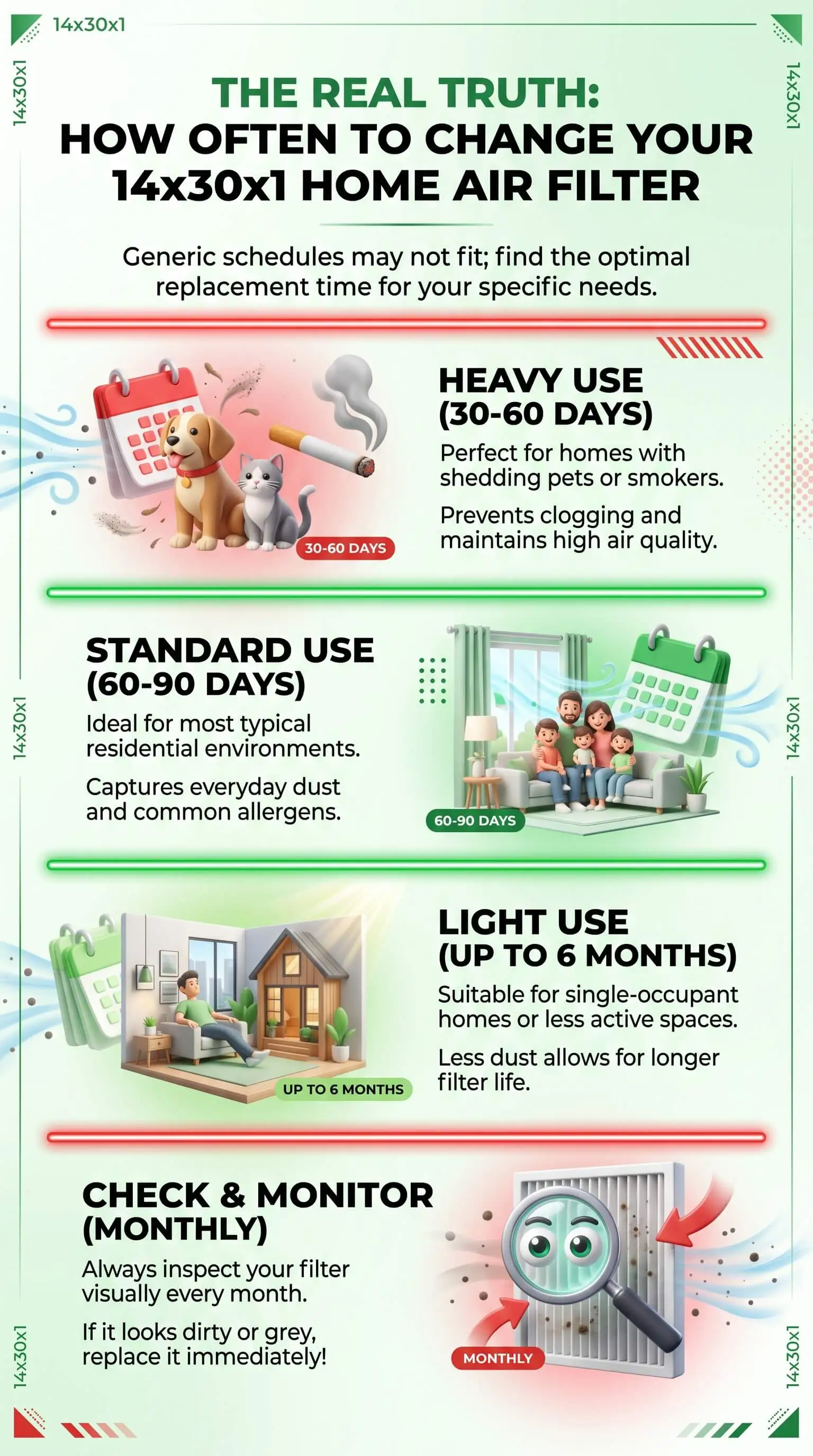
Every 60 to 90 days in an average home
Every 30 to 45 days with pets or allergy sufferers
Every 30 days during wildfire smoke events or heavy HVAC runtime
Recommended MERV rating:
MERV 11 for pet homes
MERV 13 for allergy and asthma households, if the system tolerates the pressure drop
What we see on the manufacturing floor: a 1-inch 14x30x1 loads faster than 4-inch or 5-inch media filters, so the 60-day end of the window is the safer default.
Top Takeaways
Change a standard 1-inch pleated 14x30x1 filter every 60 to 90 days in an average home.
Drop to every 30 to 45 days if you have pets, allergy sufferers, or heavy HVAC runtime.
The 14x30x1's 1-inch profile loads faster than 4-inch or 5-inch media filters, so the schedule is tighter.
A dirty filter costs you airflow, energy, and equipment life, not only indoor air quality.
Inspect monthly during peak heating and cooling seasons and replace on sight if the pleats look gray or coated.
How Often to Change a 14x30x1 Home Air Filter
Replace a standard 1-inch pleated 14x30x1 every 60 days in an average home. Stretch to 90 days only if you have no pets, no allergy sufferers, and light HVAC runtime.
The reason this size loads faster than a 4-inch or 5-inch media filter comes down to surface area. A 1-inch pleat pack holds a fraction of the filtration area of a deep-pleat media filter, so household dust fills it sooner and airflow resistance climbs sooner. What we see in the filters customers send back to our facilities lines up with EPA guidance for residential furnace and HVAC filters: 60 to 90 days is the practical range, and anything past that is borrowed time.
Here is the quick cadence we use when homeowners call us:
Average home, no pets: every 90 days.
Average home with one pet: every 60 days.
Multiple pets or allergy sufferers in the home: every 30 to 45 days.
Heavy cooling or heating season: inspect every 30 days and swap on sight if the pleats look loaded.
What the 14x30x1 Size Tells You About Your System
A 14x30x1 slot is almost always a return-grille filter, mounted in a ceiling or wall and accessed directly through the grille itself. The 1-inch profile means your system was engineered around a thinner, faster-loading filter, which is worth knowing because it shapes how aggressive you need to be with your change schedule.
One detail trips up a lot of homeowners when it comes to choosing the right filter for HVAC. Nominal size is not actual size. A filter labeled 14x30x1 typically measures about 13.5 by 29.5 by 0.75 inches, because the label describes the slot it fits, not the filter's exact edge-to-edge dimensions. If your current filter slides in snugly with no gaps around the frame, you have the right size.
7 Signs Your 14x30x1 Filter Needs Changing Now
If you are between scheduled change dates and weighing whether to swap early, these are the signals we trust most after years of looking at returned filters and diagnosing weak-airflow complaints:
A gray or brown coating across the intake side of the pleats, visible the moment you pull the filter out of the return.
Noticeably weaker airflow at your supply registers compared with the week you installed the current filter.
Longer HVAC run times to reach the same thermostat setting.
More dust settling on furniture within a week of cleaning.
Allergy or asthma symptoms that feel worse indoors than outdoors.
A musty or dusty smell from the return grille when the system kicks on.
Higher energy bills with no change in weather or usage patterns.
One of these, and you should check the filter this week. Two or more, and you are already past due.
How Your Household Changes the Schedule
No two homes load a filter at the same rate, and the 60-to-90-day window moves around based on who and what is inside the house. These are the variables that have the biggest effect on loading speed and improving home air quality, based on what we see in the field:
Pets: dander and fur shorten the interval. One dog or cat drops the cadence to 60 days. Two or more, and you are in 30-to-45-day territory.
Allergies and asthma in the household: shorten the interval further and consider a higher MERV rating, up to MERV 13 if your system can handle the pressure drop.
Wildfire smoke or poor outdoor air quality events: inspect every two weeks while the event is active. Swap on sight if the pleats show discoloration.
Remodeling, sanding, or heavy dust from a project: replace the filter the same day the work wraps.
Vacant home or minimal HVAC runtime: you can stretch closer to 90 days safely.
Humid climates with long cooling seasons: more runtime means more loading per year, so plan on the shorter end of each range.
What Happens If You Wait Too Long
A clogged 14x30x1 does not sit quietly in the return doing nothing. It actively works against the HVAC system behind it, and the damage compounds the longer the filter stays in the slot.
Airflow drops, and the blower motor runs longer and hotter to move the same volume of air.
Dust bypasses the loaded filter through gaps in the frame and collects on the evaporator coil, cutting cooling efficiency.
In winter, restricted airflow pushes furnaces past their high-limit temperature and triggers shutoff cycles.
In summer, weak airflow across the coil can freeze it solid, leaving you with warm air at the vents on a 95-degree day.
Indoor particulate counts creep upward, which is the opposite of what the filter is there to prevent.
A filter swap takes about 15 minutes and prevents every item on that list. That is the trade-off the brand directly stands behind: a small amount of maintenance protects your family's air, your HVAC equipment, and your energy bills at the same time.
“What we see most often in returned 14x30x1 filters is homeowners stretching them past 90 days in heavy cooling months, and by that point the blower motor is already paying for the delay in added runtime and added wear.”
7 Essential Resources
These are the authorities we point homeowners toward when they want the research behind what we see on the manufacturing floor. Every link below is a government or nonprofit source.
1. Get the EPA's Replacement Window Straight from the Agency
The EPA's consumer guide to air cleaners in the home puts the manufacturer-recommended replacement window at every 60 to 90 days for furnace and HVAC filters, with more frequent replacement when the filter looks heavily soiled. Our take from more than a decade of watching filters come back through our returns line: for a 1-inch 14x30x1 in a typical home, 60 days is the safer default. We see more filters fail from being stretched than from being changed too soon.
Source: EPA Guide to Air Cleaners in the Home
2. Understand Why Indoor Air Matters More Than You Think
The EPA's Indoor Air Quality hub makes the public health case for filtration, ventilation, and source control as the three pillars of cleaner indoor air. In our work with customers, the filter is almost always the first pillar they actually touch, and a 14x30x1 change on schedule is doing more work than most people realize. Bookmark this one if you want the broader context behind every filter change.
Source: EPA Indoor Air Quality (IAQ) Hub
3. Decode the MERV Rating on Your 14x30x1 Before You Buy
MERV is the rating system the industry uses to describe how well a filter captures particles of different sizes, and ASHRAE established it under Standard 52.2. From manufacturing thousands of different SKUs, here is the practical translation we give our customers: MERV 8 is the baseline for everyday dust, MERV 11 is the sweet spot for pet homes, and MERV 13 is where allergy and asthma households should aim if their system can handle the pressure drop.
Source: ASHRAE Standard 52.2 (Method of Testing General Ventilation Air-Cleaning Devices)
4. Learn How Indoor Air Pollution Actually Affects Your Family
The EPA's Introduction to Indoor Air Quality explains how immediate and long-term exposure to indoor pollutants can affect respiratory and cardiovascular health, and why children, older adults, and chronically ill family members face the highest exposure because they also spend the most time indoors. A filter change feels different once you read this. It is not just equipment maintenance. It is a decision that shapes what the people you love are breathing for the next two months.
Source: EPA Introduction to Indoor Air Quality
5. Check the American Lung Association on Particle Pollution at Home
The American Lung Association treats indoor particle pollution as a core driver of respiratory harm, which lines up with what a well-maintained 14x30x1 can help address. What we take from their guidance in our own materials: source control beats filtration on its own, but a clean filter changed on time multiplies whatever source control you are already doing at home.
Source: American Lung Association: Indoor Air Pollutants
6. See the ENERGY STAR Case for Regular Filter Maintenance
ENERGY STAR, run jointly by the EPA and the Department of Energy, names monthly filter inspection as one of the single most effective moves a homeowner can make for HVAC efficiency. After a decade-plus of watching what neglected filters do to blower motors and coils, we agree with the emphasis. A dirty filter is not only an air quality issue. It is an energy and equipment issue that compounds every day the filter stays in the slot.
Source: ENERGY STAR: Heat and Cool Efficiently
7. Follow the ENERGY STAR Maintenance Checklist Month by Month
The ENERGY STAR maintenance checklist breaks HVAC upkeep into seasonal and monthly tasks, with filter inspection at the top of the monthly list. We build our filter auto-delivery schedules around this same rhythm because it works. Customers who tie their filter check to a fixed monthly habit, like the first of the month or the day they pay the utility bill, almost never overshoot a 60-day change window.
Source: ENERGY STAR Maintenance Checklist
3 Statistics
Every statistic below comes from a verified government source. Each one reframes why the 14x30x1 in your return grille matters more than a routine chore.
Stat 1: Americans spend about 90 percent of their time indoors
The EPA's long-running guide to indoor air quality reports that people in the United States spend roughly 90 percent of their time indoors, and that indoor air can be more polluted than the outdoor air around the home. From the filters we pull and test in our own facilities, that statistic carries a practical edge. Nine out of every ten breaths your family takes happen inside the envelope your HVAC system is conditioning, and a loaded 14x30x1 shapes every one of them.
Source: EPA: The Inside Story, A Guide to Indoor Air Quality
Stat 2: Heating and cooling account for 52 percent of home energy use
The U.S. Energy Information Administration's most recent residential energy survey shows that space heating and air conditioning account for 52 percent of an average household's annual energy consumption. What this means for your 14x30x1: the single biggest energy draw in your home has to push air through whatever filter is sitting in the return, and a clogged 1-inch filter turns that draw into a tax you pay every month. We see the result in blower motors that arrive at our facilities worn well ahead of their expected life.
Source: U.S. EIA: Use of Energy in U.S. Homes
Stat 3: Indoor pollutant levels can run 2 to 5 times higher than outdoor levels
The EPA reports that concentrations of some indoor pollutants can run two to five times higher than typical outdoor concentrations, and occasionally higher still. That gap is the space a 14x30x1 is engineered to close. From what we see in our field data, a filter changed on a 60-day cycle pulls a steady stream of particulate out of circulation, while one left in the past 90 days starts letting more of it slip back through the airstream.
Source: EPA Report on the Environment: Indoor Air Quality
Final Thoughts and Opinion
If you want the shortest honest version of what more than a decade of manufacturing has taught us, here it is. A standard 1-inch 14x30x1 pleated filter should come out every 60 days in most homes, and every 30 to 45 days in homes with pets, allergy sufferers, or heavy HVAC runtime. The “every 90 days” advice you see repeated across the internet ignores the two variables that actually control loading: who lives in the home, and where the home is.
Our opinion, plainly stated: treat a filter change as a 15-minute investment in both your family's air and the equipment behind your walls. A basic air filter changed on time will outperform a premium filter left in for six months, because no MERV rating survives being left in a humid return slot for half a year. The cheapest mistake we see in the field is the one where a homeowner bought the better filter, forgot about it, and learned the hard way.
Frequently Asked Questions
Q: How often should I change my 14x30x1 air filter?
A: Every 60 to 90 days for a standard 1-inch pleated 14x30x1 in an average home. Drop to every 30 to 45 days with pets or allergy sufferers in the home, and closer to 90 days in lightly used or vacant homes. Inspect monthly during peak heating and cooling seasons.
Q: Is a 14x30x1 the same as a 14-inch by 30-inch by 1-inch filter?
A: Yes. The actual filter typically measures about 13.5 by 29.5 by 0.75 inches. Filters are labeled by nominal size to match the return slot, not by exact edge-to-edge dimensions.
Q: Can I use a higher MERV rating in a 14x30x1 slot?
A: You can, within limits. MERV 8 handles standard household dust, MERV 11 fits most homes with pets, and MERV 13 is the ceiling most residential systems will tolerate without restricting airflow. If you are unsure whether your system can handle a MERV 13, ask your HVAC technician before making the switch.
Q: What happens if I leave my 14x30x1 in for 6 months?
A: Replace it the same day you notice. Then check the evaporator coil and blower compartment for dust buildup, and book an HVAC tune-up if airflow has been noticeably weak. Six months on a 1-inch filter almost always means the system has been fighting restricted airflow for weeks.
Q: Do 14x30x1 filters work for both heating and cooling?
A: Yes. The same return filter serves the furnace in winter and the air handler in summer. The filter does not know which season it is. Only the loading rate changes with the weather and system runtime.
Q: Are washable filters a good choice for a 14x30x1 slot?
A: For most homes, no. Washable filters tend to carry low MERV ratings, require thorough drying to avoid mold growth, and underperform pleated disposables on residential indoor air quality. A pleated MERV 8 or MERV 11 disposable change on schedule beats a reusable at this size almost every time.
Q: How do I know the 14x30x1 I am buying will fit?
A: Pull your current filter and read the size printed on the cardboard frame. If it says 14x30x1, a new filter with the same label will fit the same slot. If it slides in with no gaps and no bending, you have the right size.
Protect Your Home's Air, Starting This Week
You are the one who keeps your home running well, and a 14x30x1 swapped on schedule is one of the simplest ways to protect your family's air and your HVAC system in the same 15 minutes. When you are ready for the next filter, Filterbuy ships American-made pleated filters in the MERV rating that matches your household, so the next 60 days start with cleaner air and equipment that is not fighting to do its job. Find your 14x30x1 replacement filter and set up auto-delivery, and you can stop thinking about the schedule altogether.