
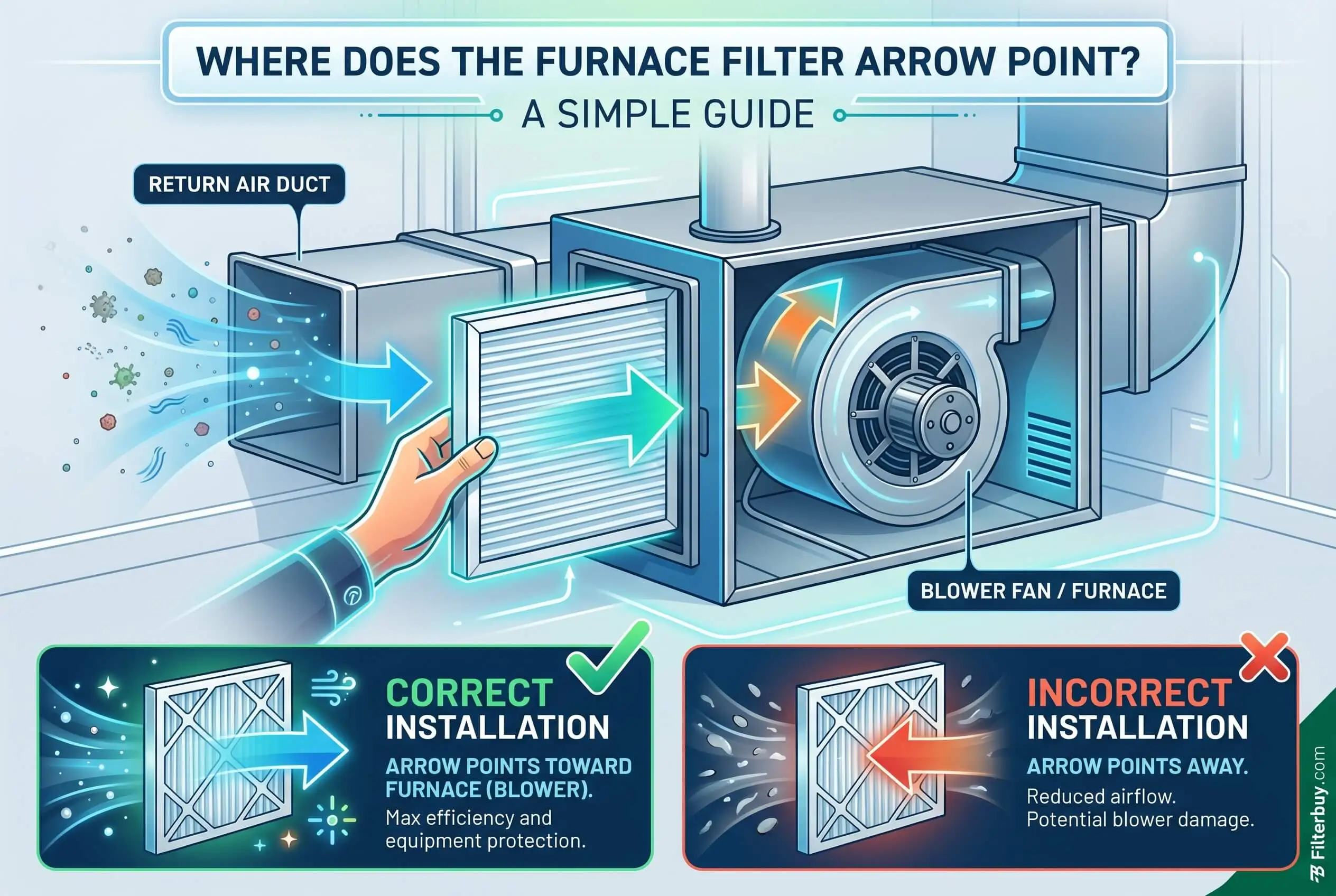
Find the arrow on the side of your filter and point it toward the furnace. Every filter we’ve handled on a service call has that arrow printed somewhere on the cardboard frame, and it always points the same way: into the blower motor, in the direction the air is already moving. Get that right when checking which way does air filter go in furnace, and the rest of the install takes about ninety seconds in most homes we work in.
That is the whole rule. Why the rule matters, what trips homeowners up, and what to do when your filter doesn’t have an arrow at all are what we walk through below.
TL;DR Quick Answers
Which way does air filter go in furnace?
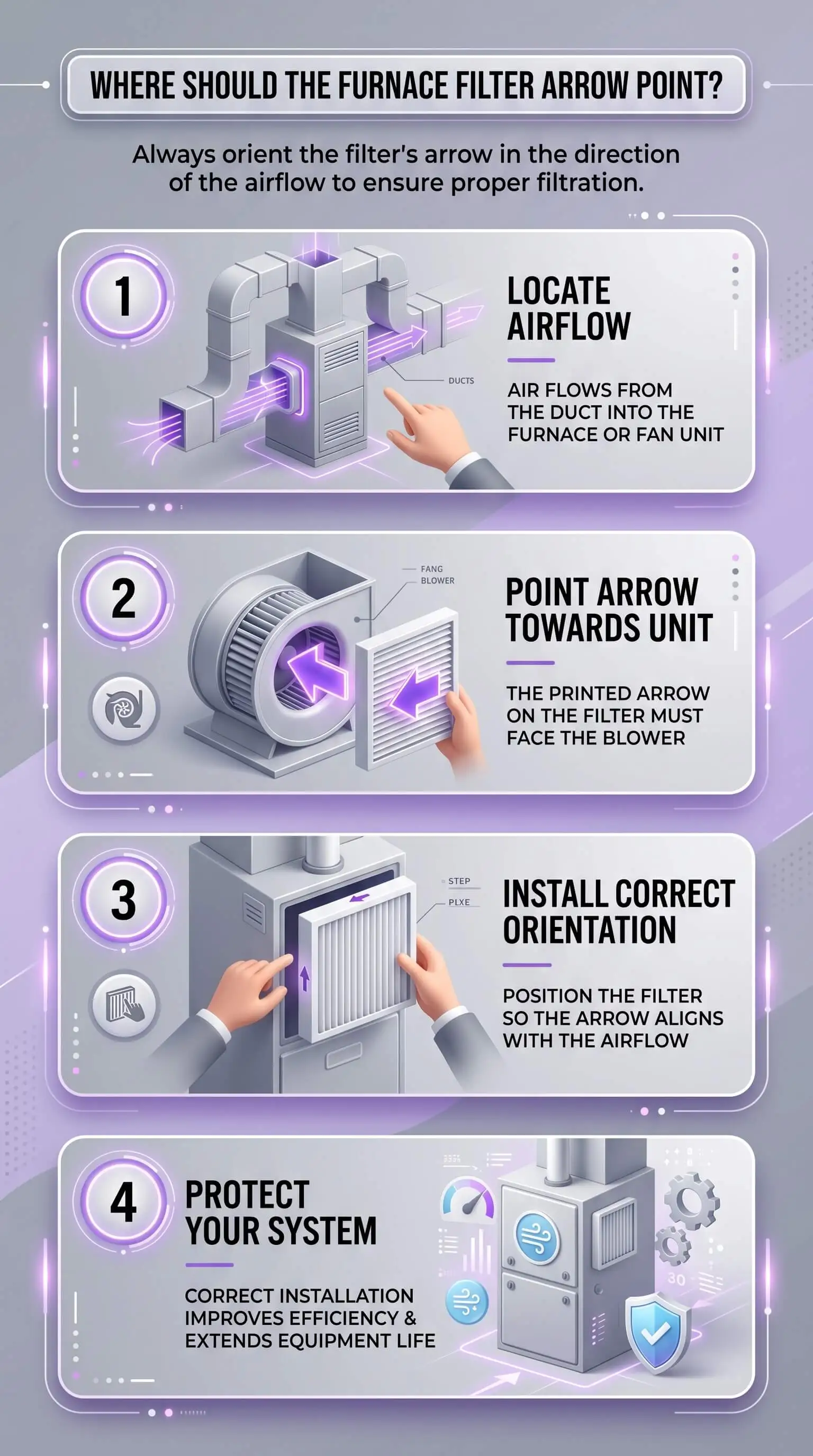
Point the arrow on the side of your filter toward the furnace, in the same direction the air is moving. That rule holds in every setup we've worked in: upflow, downflow, horizontal, and wall-grille returns. If the arrow aims back toward the room or the return vent, flip the filter.
Arrow toward the blower, every time. That direction matches the airflow leaving your return vents.
Open media faces the return air. The denser, stiffer pleat side faces the blower.
Filters without an arrow. The wire mesh backing always faces away from the blower.
Top Takeaways
The arrow on a furnace filter points toward the furnace and into the blower motor, the same direction the air is already moving.
Air travels through the system in this order: return vent, filter, blower, supply ducts.
The arrow follows the air: up on upflow furnaces, down on downflow units, sideways toward the blower on horizontal setups.
If the filter has no arrow, the denser side of the media faces the blower and any wire mesh backing faces away from it.
A backward filter restricts airflow, wears the blower motor faster, and quietly raises the utility bill.
The airflow path
Air pulls out of the rooms through the return vents, crosses the filter, hits the blower, runs over the heat exchanger or evaporator coil, and rides the supply ducts back into the house. Choosing the right air filter matters because the filter sits in the middle of that path, between the return and the blower. The arrow on the frame follows the same direction the air does.
Arrow direction by furnace type
Which way the arrow points in space depends on the furnace’s orientation. We work on all three configurations in the same week.
Upflow furnace, basement install. Air enters at the bottom, climbs through the cabinet, leaves at the top. The arrow points up.
Downflow furnace, attic or upper-floor install. Air enters at the top, falls through, leaves at the bottom. The arrow points down.
Horizontal furnace, closet or crawlspace. Air moves sideways through the unit. The arrow points horizontally toward the blower side.
The rule never moves: arrow toward the blower, every time. Only the furnace’s orientation in the house changes from one home to the next.
Reading the arrow on the frame
Most filters print the arrow on at least two sides of the cardboard frame. That detail helps, because half the time the slot only shows you one edge once the filter is most of the way in. If the printed arrow has rubbed off, look at the media itself. The denser, stiffer pleat side faces the blower. The looser, more open side faces the return air.
For a side-by-side walkthrough across upflow, downflow, and horizontal setups, this step-by-step furnace filter installation guide shows each one with photographs.
No arrow on the frame
Some basic fiberglass filters skip the arrow entirely. In that case, the denser side of the media still faces the blower and the looser side still faces the return air. If a wire mesh backing sits on one face of the filter, that mesh is structural reinforcement against the fan’s pull. The mesh points away from the blower.
Ceiling and wall returns
Some homes hold the filter at the return grille itself, in a wall or ceiling, rather than inside the furnace cabinet. The rule still holds. The arrow points into the ductwork, toward the equipment, because that is the direction the air is already moving.
What a backward filter looks like
Furnace filter replacement makes those warning signs easier to catch before they become bigger problems. The cardboard frame bows outward on the side facing the room, because the suction is dragging on the wrong layer of media. A ridge of dust collects on the side that should be the clean one. The blower runs longer than it should to hold the thermostat setpoint. Over the next few months, the homeowner’s utility bill drifts up a few dollars without anything else in the house changing.
“On any low-airflow service call, the first thing we check is the filter, and the second thing is the arrow. We see backward filters more often than people would guess, usually in a home that just changed hands or where someone other than the regular homeowner handled the last filter change. The story is dust loaded on the wrong side of the media. Once we flip it and confirm a top furnace filter is installed correctly, the supply registers wake right back up.”
7 Essential Resources
These are the primary sources we keep open in our own browser tabs when answering filter questions.
Air filter (Wikipedia). en.wikipedia.org/wiki/Air_filter. Covers how particulate air filters work and the materials inside them.
Maintaining Your Air Conditioner (U.S. Department of Energy). energy.gov/energysaver/maintaining-your-air-conditioner. DOE filter replacement guidance and the source of the 5% to 15% efficiency figure cited below.
Air Conditioner Maintenance (U.S. Department of Energy). energy.gov/energysaver/air-conditioner-maintenance. Walks through airflow, coil care, and where filters typically sit in a central system.
Home Heating Systems (U.S. Department of Energy). energy.gov/energysaver/home-heating-systems. Heating-side maintenance basics, including filter cadence on furnaces.
Heat & Cool Efficiently (ENERGY STAR). energystar.gov/saveathome/heating-cooling. Replacement cadence, the energy share of HVAC in a typical home, and seasonal tune-up guidance.
HVAC Maintenance Checklist (ENERGY STAR). energystar.gov/saveathome/heating-cooling/maintenance-checklist. What homeowners should check monthly, plus what belongs on a contractor’s annual visit.
Guide to Air Cleaners in the Home (EPA). epa.gov/indoor-air-quality-iaq/guide-air-cleaners-home. MERV ratings, filter selection, and what residential HVAC equipment can actually accept.
3 Statistics
5% to 15%. The U.S. Department of Energy reports that replacing a dirty, clogged filter with a clean one can lower an air conditioner’s energy consumption by 5% to 15%. Source: energy.gov.
Nearly half. ENERGY STAR puts heating and cooling at roughly half of all energy use in a typical U.S. home. That share is why small inefficiencies at the filter level show up so quickly on a utility bill. Source: energystar.gov.
MERV 13 or higher. The EPA recommends a filter with at least a MERV 13 rating, or the highest rating the system fan and filter slot can accommodate, for homeowners looking to upgrade indoor filtration. Source: epa.gov.
Final Thoughts and Opinion
Filter direction is one of the few HVAC details where getting it right costs no extra time and no extra money. A two-second glance at the arrow before the filter goes in is the whole investment. In exchange, the system runs at its rated airflow and the filter performs at its rated MERV.
The mistake we see isn’t laziness. It’s the homeowner who flips the filter to read the size label, runs into a furnace filter size issue, loses track of which way it was facing, and slides it back in the wrong direction. Pull it out, find the arrow, point the arrow at the blower, slide the filter back in. That is the whole job.
Frequently Asked Questions
Does the arrow on a furnace filter point toward the furnace or away?
Toward the furnace. The arrow follows the airflow into the blower motor, which means it always points away from the return vent and into the equipment. If the arrow on your filter aims back toward the room or back toward the return grille, the filter is in backward and needs to be flipped.
Which way does the arrow point on a horizontal furnace?
On a horizontal furnace, the arrow points sideways toward the blower side of the cabinet. Air moves horizontally through the unit, so the filter follows along. The rule is identical to upflow and downflow setups. What changes from one home to the next is the furnace’s orientation, not the rule itself.
What do I do if my filter has no arrow printed on the frame?
Look at the filter media instead. The denser, stiffer side faces the blower and the looser, more open side faces the return air. If the filter has a wire mesh backing on one face, that wire face is the support side and points away from the blower.
Can I install a furnace filter upside down?
If the arrow still points toward the blower after you rotate the filter, upside down is fine. The arrow is the only marker that matters. Long-axis rotation has no effect on airflow. Spin the filter however you need to, then check the arrow before it goes in.
Will running my furnace with the filter in backward damage it?
A single cycle won’t break anything. Extended operation with a backward filter wears the blower motor faster, loads the wrong side of the media, and cuts both airflow and filtration. Worth flipping the next time you’re near the furnace.
Get the Direction Right the First Time
Bookmark this walkthrough on the correct furnace filter direction for the next filter change. It lays out every common setup with photographs and a clean six-step install.